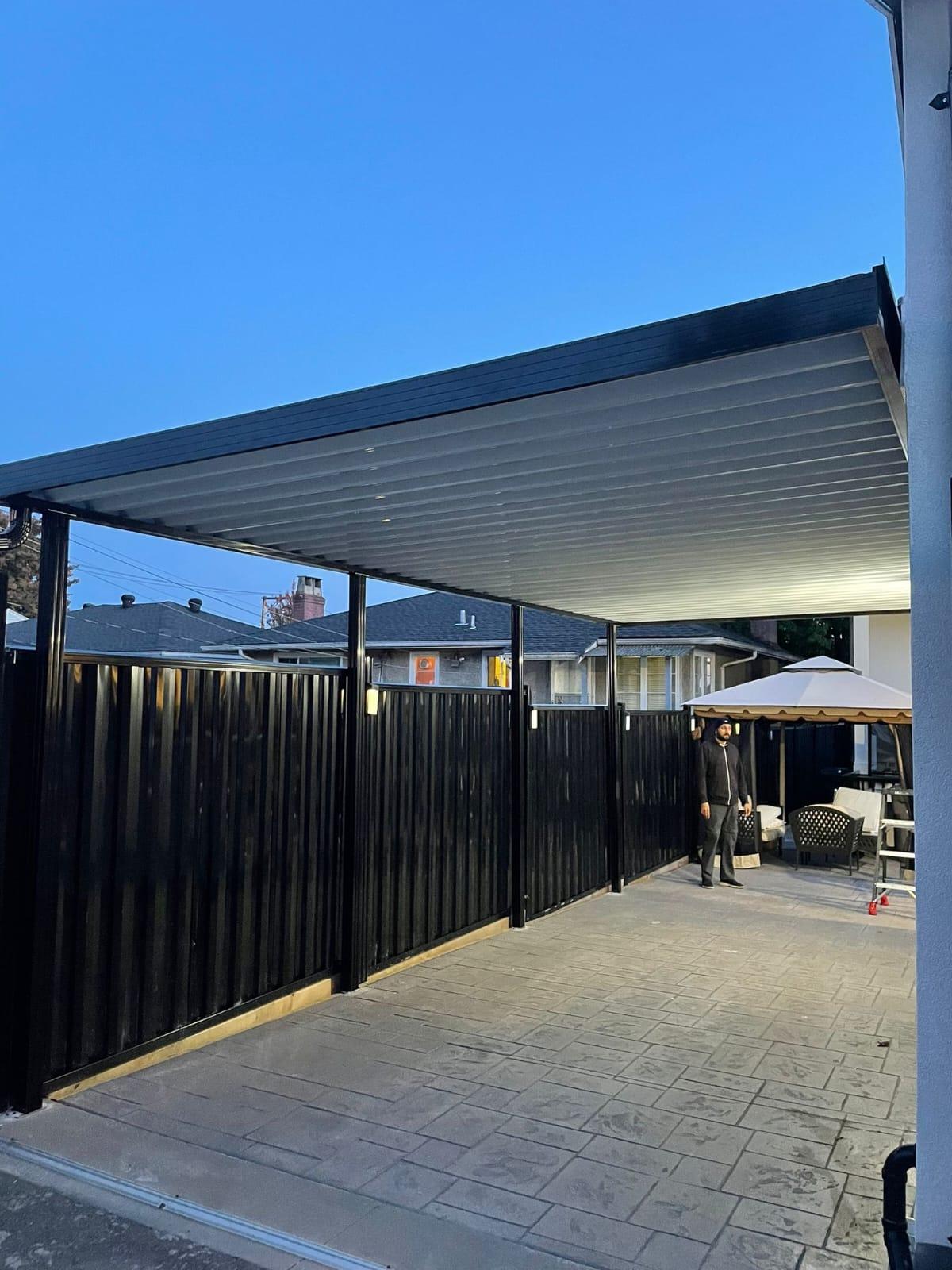
In Fletcher Hills, the sun clears the ridge to the east around 7 AM and tracks across a cloudless sky until it drops behind Cowles Mountain at dusk. There is no coastal breeze, no marine layer, and no natural shade in most backyards. By 11 AM on a July day the concrete patio reads 140 degrees. Homeowners in this part of El Cajon do not need convincing about the value of a patio cover — they need a crew that understands the thermal demands the East County climate places on structures, and materials engineered to meet them.
San Diego Aluminum has been installing aluminum patio covers throughout El Cajon since the early 2010s. We have done projects in every neighborhood from downtown El Cajon to the canyon edges of Crest, and we understand how summer heat cycles, cold December nights, and periodic Santa Ana conditions stress the connection between a patio cover and a home’s roof framing. Our installations are engineered for El Cajon’s conditions, not designed for a coastal site and adapted after the fact.
Thermal Performance: Why East County Is Different
Aluminum expands and contracts with temperature change. In coastal San Diego, the daily temperature swing is modest — 60 to 75 degrees is a typical summer range. In El Cajon’s inland valley, a summer day commonly runs from 65 degrees at dawn to 102 degrees at 3 PM. That 37-degree swing is nearly double the coastal range, and it happens every single day from June through September.
Poorly engineered patio covers handle this thermal cycling by cracking their paint, loosening their fasteners, or developing stress fractures at bracket connection points. Our East County installations use expansion-rated fasteners at all roof tie-in points and allow appropriate clearance gaps where aluminum panels meet fascia boards. It is a detail that most homeowners never see, but it is the reason our El Cajon covers from 12 years ago are still tight and clean while some competitors’ installations from 6 years ago show gapping and paint failure.
Santa Ana wind events add a separate engineering consideration. When October and November bring hot, dry offshore winds at 40 to 60 mph through El Cajon’s valley orientation, a patio cover that was not properly anchored will lift, rack, or partially detach. We engineer for El Cajon’s wind exposure, not the coastal standard, and our structural calculations are prepared by a licensed engineer rather than pulled from a generic template.
Popular Patio Cover Styles for El Cajon Homes
The standard El Cajon recommendation is a solid insulated patio cover — every time. The foam-core insulated panels block 100% of UV radiation and reduce the temperature beneath the cover by 10 to 15 degrees compared to the ambient air temperature in direct sun. For a patio that would otherwise be unusable at 102 degrees, that means the difference between 87 degrees with airflow from a ceiling fan and a concrete pad you cannot stand on barefoot.
Lattice covers are popular in El Cajon for homeowners who want some sunlight to reach their patio plantings, or for properties where the HOA guidelines specify an open structure. Lattice does not provide the same thermal benefit as insulated solid panels, but it dramatically reduces direct UV exposure and gives significant relief from the hardest sun angles. For homes with east-facing patios that only receive morning sun, lattice is often the right balance.
Aluminum carports are a strong product in El Cajon. Vehicle paint and interior dashboards take heavy punishment from East County UV exposure, and many El Cajon homes have driveway space where a carport makes practical sense. We install both attached and freestanding carport configurations throughout the city.
If your project involves pouring a new concrete slab alongside the patio cover, our partner SD Concrete Pros’ concrete slab specialists handle East County concrete work — a useful pairing that saves coordination time when both trades are scheduled together.
El Cajon Neighborhoods We Serve
We install throughout El Cajon’s full geographic range. Fletcher Hills and Granite Hills are among our highest-volume neighborhoods — both feature hilltop and canyon-rim homes with south and west exposures that demand solid shade. Downtown El Cajon and Bostonia have a mix of older ranch homes and mid-century properties that are popular targets for cover installations, often as part of broader backyard remodels.
Rancho San Diego, in unincorporated county territory east of El Cajon proper, is a frequent installation area. Crest and Dehesa further up the canyon are less dense but we cover them regularly.
We also serve the broader East County corridor: La Mesa, Santee, Spring Valley, Lemon Grove, and the Grossmont area. For adjacent city coverage, see our pages on Escondido patio covers and Poway aluminum patio covers.
El Cajon Building Permits
Attached patio covers in El Cajon require a building permit from the City of El Cajon Building Division. The submittal package must include engineered structural calculations, a site plan with setback dimensions, and — for attached covers — a detail showing the ledger attachment to the home’s wall or roof framing. The El Cajon Building Division processes residential patio cover permits within approximately 2 to 3 weeks for straightforward applications.
We manage the full permit cycle from submittal through final inspection. For El Cajon properties in unincorporated San Diego County — Crest, Dehesa, and rural Granite Hills — permits go through County DPS in Santee, which has slightly longer review times; we account for that in project scheduling.
Frequently Asked Questions — El Cajon Patio Covers
Does the heat in El Cajon affect how long a patio cover lasts?
Aluminum is one of the few structural materials that is not degraded by heat cycling. The powder-coat finish uses UV-stabilized pigments that resist the fading and chalking that standard paint shows after a few East County summers. A properly installed aluminum cover in El Cajon will look and perform the same after 20 years as it did after 2.
What is the turnaround time from estimate to installation?
For a standard El Cajon project without HOA involvement, the process typically runs 4 to 6 weeks: engineering (1 week), permit submittal and approval (2 to 3 weeks), and installation (1 to 2 days). We book installations in order of permit approval, so starting the permit process early directly shortens your wait.
Do El Cajon homes typically have HOA restrictions on patio covers?
Most of El Cajon proper is not governed by HOAs. Exceptions include newer Rancho San Diego communities. Fletcher Hills, Bostonia, Granite Hills, and downtown El Cajon are almost entirely non-HOA. We confirm HOA status at the estimate appointment.
Get a Free Estimate in El Cajon
Call San Diego Aluminum at (858) 299-8559 or email [email protected]. We provide free on-site estimates throughout El Cajon and East County. Our estimator will assess your patio, take measurements, and give you a detailed written quote with no pressure and no obligation.
San Diego Aluminum
Phone: (858) 299-8559
Email: [email protected]
Serving El Cajon, Fletcher Hills, Rancho San Diego, Crest, and all of East County
Get a Free Quote Today
Ready to get started? Contact us for a free consultation and custom estimate for your project.